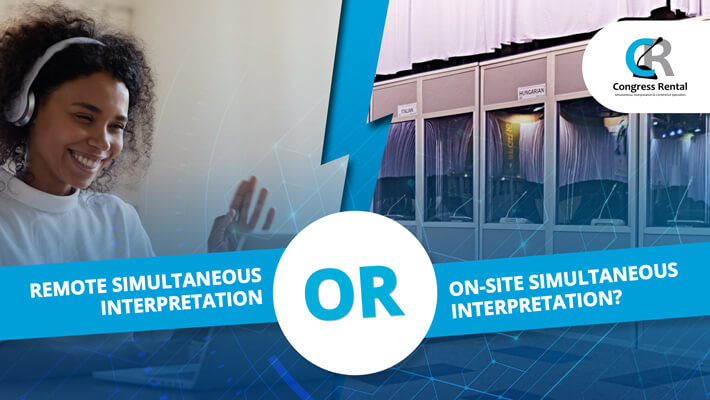
The idea of remote working is slowly becoming further entrenched in the conferencing arena and businesses are subsequently opting for virtual events in an effort to keep delegates safe during times of unprecedented change. With the progressive increase in virtual events, Remote Simultaneous Interpretation (RSI) has subsequently come to life like never before. Admittedly, we believe that the virtual event arena is not without its set-backs, especially when it comes to hosting a variety of languages. As such, organisations should weigh up the pros and cons of both RSI and on-site interpretation before hosting their next event.
In a recent study conducted by Paris-based École Supérieure d’Interprètes et de Traducteurs (ESIT), it was found that remote simultaneous interpretation is more difficult for 84% of interpreters. From our standpoint, the concern is that an increase in difficulty, and other technical factors, could lead to burnout or mental drain on the interpreters. However, with that being said, the same study found that 64% of the respondents said they would like to continue working on RSI assignments.
In Support of On-Site Simultaneous Interpretation
Simultaneous Interpretation is without a doubt, a unique combination of science, technology and inherent skill. Since technology is such an important factor, ensuring success is easier guaranteed when the interpreters are on-site with easy access to immediate technical support when required. With RSI, interpreters no longer have boothmates so there is no one to assist with conducting urgent research, taking notes and so on.
RSI also requires interpreters to do extra tasks that they would normally not need to do when interpreting a conference in a traditional booth. This includes communicating with others by typing messages (which in itself, is time consuming) and having to answer questions and receive instructions from others (such as ‘we can hear background noise’) while busy interpreting.
On-site interpreting requires the service provider to travel to the required destination, enabling them to work within that specific time zone. This is important because with RSI, a different time zone could mean that an interpreter has to interpret a complex conference at 11pm after working their normal 8 hour day.
In Support of Remote Simultaneous Interpretation
With RSI, geographic location is no longer a barrier and interpreters are more able to continue working and servicing events across the globe. This also lends itself to increased flexibility, where interpreters are able to accommodate events at short notice.
Remote Simultaneous Interpretation is also a lot more cost effective as it reduces the budget needed for travel, accommodation and equipment. Additionally, it enables conference organisers to increase the number of languages offered as there is no longer the need to fly interpreters out to events.
So there you have it- the upside and downside of both RSI and on-site Simultaneous Interpretation. While RSI has a strong standing in the market, we believe that in-person conferencing and on-site interpretation will always be the most effective option. For detailed enquires on both options, call Congress Rental, the conference and simultaneous interpretation specialists on +27112169640.